Monday, July 1, 2019

Harry the long term volunteer!


My name is Harry Johnson and I am with MCSS for 5-6months of volunteering. After graduating from my Master’s, I decided I needed some practical conservation/research experience. I chose MCSS because of their project on Temporal Protected Areas.
Investigating a possible turtle nest
Additionally, the Western Indian Ocean is an area which has received less scientific attention than others e.g. the North Atlantic in the field of marine science /conservation. This means it can be argued that data collected in this geographic area disproportionately more value than elsewhere.
Beach profiling with the ladies!

So far, I have learned how to feed and care for a variety of chelonians, learnt the protocols for beach patrols and what data to collect. Other skills include what to do from a research perspective when encountering a turtle that is nesting or attempting to nest. More novel skills include how to use a machete. I intend to broaden my skill set as much as possible during my time here and am confident that I will be a better researcher/ conservationist by the end of it. I have three personal goals as well; to improve my diving, to climb Morne Seychellois, and to see as much of the wildlife the Seychelles has to offer.

Monday, June 24, 2019

Ambre's intoduction


Hi! I am Ambre Chabert and I come from Marseille, south of France. I have a degree in biodiversity and ecology, and I am going to start a master's degree in marine ecology (IMBRSea). I have always been interested by the ocean and its secrets. Therefore, I would like to become a marine ecology researcher.
conducting beach patrol

To gain more field experience, I am now an intern at the Marine Conservation Society Seychelles, as part of the Temporal Protected Areas project. For this project, we, along with other interns/volunteers and Vanessa (the project coordinator), conduct beach patrols to monitor nesting turtles. As it is not the peak nesting season, we monitor anthropogenic disturbance to evaluate factors that could be an obstacle for nesting turtles. There are only two species of turtle that nest in the Seychelles: the hawksbill turtle and the green turtle; critically endangered and endangered respectively. The hawksbill turtle nesting season is from October to January, whereas green turtles nest all year round. In fact, there is a green turtle nest currently and we might have to relocate it, since it is washed away by waves. MCSS monitors nesting turtles, identifies them, monitors the nests, relocates them if necessary and escorts the hatchlings to the sea when encountered. By doing so, they discourage poachers and increase the chances of survival of the hatchlings.

water quality testing
I also participate in other projects: monitoring terrapin population, birds, marine litter, water quality, invertebrates and undertaking coral restoration. Finally, I help at the Banyan tree center with chelonian care and maintenance.

In one week, I have learnt so much and I can’t wait to see what these next 5 weeks have in store for me. 


Ambre, intern, June 2019

Tuesday, May 28, 2019

2018-2019 turtle nesting season overview


As the 2018-2019 turtles nesting season almost comes to an end, with the peak of the season long gone and hatching season also over. We have done a preliminary analysis of collected data to see how productive the season has been. In terms of encountered turtles, there were 49 encounters this year compared to 26 in the previous season 2017-2018, noting that several times these were the same turtles encountered. Moreover, far more tracks and nests have been recorded for both Hawksbill and Green turtles:
Hawksbill turtle emergences: 283
Hawksbill turtle nests: 147
Green turtle emergences: 15
Green turtle nests: 8


Rupert Stacy


My name is Rupert Stacy and I am a master’s student on the IMBRSea program, focusing on management of marine biological resources. I came to Seychelles to work with the MCSS and gain valuable insight into how their project on temporal protected areas is implemented. The idea of temporal protected areas is an interesting one. Having management plans for threatened species at vulnerable life stages is critical for conservation efforts. Thus, identifying how the project has collected, analysed and reported on seasonal habitat use of species, in this case marine turtles, I thought would be a very useful set of transferable skills that I might be able to use later in my own career.

Monday, March 25, 2019

Mylene and Maiwenn from France joins MCSS for a short internship


We are two interns at the MCSS currently working on the temporal protected area project with the help of our project leader, Vanessa. Our aim is to collect and analyse data from the main sea turtle nesting beaches and try to make it a protected area. To achieve this, we are helping on patrolling the beaches to find tracks (turtles, anthropogenic, other animals…) and checking the recorded turtle nests, to check the hatching success. 
When a nest has hatched,we excavate the nest and count the number of hatched eggs, the predated ones and the ones that didn’t make it and we collect the data .
helping a weak hatchling
 When we get some luck, as we did on the last Tuesday, we can witness the nest hatching and help the baby turtles get to the water safely  by removing obstacles in their path and guiding them as they make their imprints on the way to the sea, we can count them directly…although this can be a bit difficult ! However that was an incredible experience, something we thought we would never see !
one of the many little ones!

The other part of the time, we help at the office by taking care of the giant tortoises and the center itself. Finally part of our job is to raise awareness about the Seychelles wildlife by giving tours to the tourists and children by organising presentations and short workshops at the schools.


Breakfast time!


Tuesday, February 19, 2019

Justin's internship so far..


My internship with MCSS

Hey, my name is Justin and I am a master student in marine biology doing my thesis research in the Seychelles. Here I am studying the hatching success of the Hawksbill sea turtles in the South of Mahé island together with the staff of MCSS. I have been here now for a month and I must say that, even though I am here to work, every day feels like a holiday. 
watching out for a weak hatchling
Watching turtles nest on the beaches every couple of days, giant tortoises at my backdoor, all kinds of colourful birds flying around. Life in paradise..

Not every day is a holiday of course, because I am here on an internship studying the hatching success of hawksbill sea turtles, so my job here is to do beach patrols every other day to try and find tracks of nesting sea turtles, and by doing this, identifying nest locations. Furthermore, I have to dig up hatched nests to see what amount of young turtles made it out alive. Then I will try to link this to several environmental factors to find out what is actually the cause of a good or bad hatching success.

Other than that I always try to help out at the centre by feeding the tortoises, cleaning the terrapin tanks and cleaning up when necessary. i already learnt a lot regarding the local wildlife and  I hope I will be able to learn much more in the coming months!

Samantha's internship so far


My name is Samantha Stott, I am 22 years old and currently doing my master thesis with MCSS. The aim of my project is to assess potential Hawksbill nesting sites using an Unmanned Aerial Vehicle (UAV) in Mahé.
learning to handle the drone!

 I decided to do this project with MCSS as they have a long history of working with marine turtles. It has now been a month since I have started my project, although it did not start well due to the rainy seasons which meant we were not able to fly the drone we are now on target to finishing all the data collection thanks to the nice warm sunshine.

Every Monday, Wednesday and Fridays, I go on patrol looking for new nests and turtle tracks, some patrols have been very wet and others very hot, but it is always very rewarding when we get to see a turtle come up the beach and lay its eggs. In fact, I was lucky enough to see a turtle come up the beach and lay its eggs the second time I went patrolling. This was an amazing experience to be able get close and be able to admire such a beautiful species. However, do not underestimate how strong these beautiful turtles are…. During one of the patrols we had to restrain a Hawksbill turtle to measure its carapace and take pictures of its head for identification purposes…
Trying to get photo ID shots


 However, this never happened as it was just too strong to restrain, leaving me with scratches all over my feet and ankles (No hard feelings still love them).

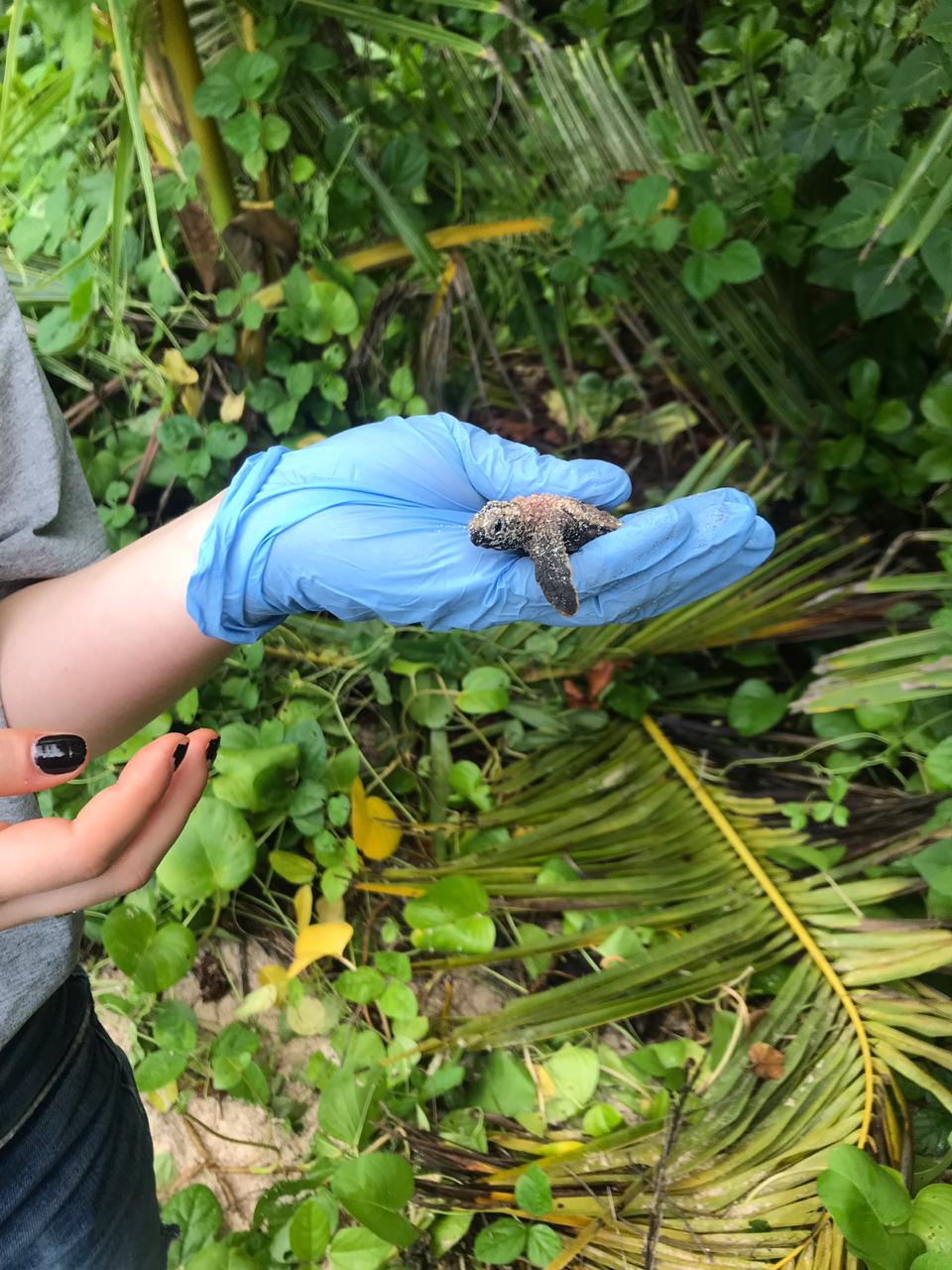
Hawksbill turtle hatchling

As time goes by, I am getting to know more about the MCSS team and the surrounding environment. I have had the opportunity to try a lot of the local food including breadfruit which is very nice even if my pallet was a bit confused as it tasted sweet like a banana but had the texture of a potato. I have not been able to get around to trying the fruit bat though… And probably won’t ever.

It is a great opportunity to be able to do what I love in such a beautiful environment. I would like to say a special thank you to Vanessa for all her guidance and support during my stay on this beautiful island.